Home  ·  Lead practice

Data Breach Forensics

Independent forensic assessment for counsel litigating data breach cases, on both sides of the caption. What happened, how it happened, and what the record will support, established before positions harden.

For: Plaintiffs’ counsel and defense counsel Delivered: Through counsel only Output: Technical memoranda

Consulting through counsel, on both sides of the aisle


Brian L. Ponder is a former New York trial attorney who now works as a consultant. The forensics practice serves plaintiffs’ counsel and defense counsel and, through counsel, their clients and carriers. All work is consulting delivered through counsel. He is the public gateway for the practice, and the analysis is performed with our technical team. The output is technical memoranda for counsel.

For Plaintiffs’ Counsel

Before filing, the question is whether a complaint’s technical allegations match the forensic record. The practice tests the intrusion narrative, the affected systems, and the categories of data involved against what the available record actually shows, so counsel files on facts that will hold.

As cases consolidate, that same assessment supports leadership applications and keeps the technical foundation consistent across briefing, discovery, and expert work.

Conflicts

Before any engagement begins, we check the matter against every matter this practice has served: parties, counsel, carriers where known, systems, and prior penetration testing work. We never serve both sides of the same breach, or of substantially related matters (the same incident, the same affected systems, or the same forensic record). We never accept a defense engagement in a matter we have touched for plaintiffs’ counsel. Conflicting work is declined outright, and we never carry information from one engagement into another. We are a small practice and do not operate personnel screens between engagements; protection is exclusion and a single conflicts register, not an internal wall.
For Defense Counsel

Defense counsel gets an independent read of the intrusion and the exposure, separate from the account in the complaint and separate from any account prepared for public disclosure. The timeline, the entry point, and the systems actually reached are established on the technical record.

Counsel then advises the client and its carrier on facts, not on the other side’s characterization, and scopes the response, the answer, and settlement discussions accordingly.

Conflicts

Before any engagement begins, we check the matter against every matter this practice has served: parties, counsel, carriers where known, systems, and prior penetration testing work. We never serve both sides of the same breach, or of substantially related matters (the same incident, the same affected systems, or the same forensic record). We never accept an engagement for plaintiffs’ counsel in a matter we have touched for the defense. Conflicting work is declined outright, and we never carry information from one engagement into another. We are a small practice and do not operate personnel screens between engagements; protection is exclusion and a single conflicts register, not an internal wall.

Services


Litigation support drawn from established security assessment disciplines, including assessment and testing methodology, network and cloud infrastructure review, and governance and compliance analysis, reframed for counsel litigating a breach.

01

Breach Forensic Assessment

A structured technical assessment of a reported breach: the timeline, the systems touched, the categories of data involved, and the gap between what has been publicly said about the incident and what the technical record shows.

02

Intrusion Vector and Affected Systems Identification

Identification of the software, service, or configuration the intruder used to get in, and the systems and data stores reached, stated in language counsel can plead, answer, or advise on.

03

Technical Review of Complaints

For plaintiffs’ counsel, a line-by-line technical review of a draft or filed complaint against the available forensic record: a Full Complaint Teardown. For defense counsel, the mirror review of a filed complaint’s technical allegations. Output is a technical memorandum for counsel, never a pleading.

04

Discovery and Expert Support

Technical support to counsel through discovery: document and log review, deposition preparation on technical topics, and support for testifying experts, so the technical record is developed completely and consistently.

05

Leadership and Strategy Support in Consolidated Actions

In consolidated data breach class actions, technical assessment and strategy support for counsel seeking or holding leadership, including comparative assessment of the competing complaints’ technical foundations.

06

Settlement Posture Analysis

A technical read of what the forensic record does to settlement value on either side: the strength of the intrusion narrative, the defensibility of the affected-systems scope, and the points an opposing expert is most likely to press.

Engagement and pricing, stated plainly


For defense counsel

Engagements are scoped after an initial assessment and quoted in writing before work begins. No defense-side prices are listed, because the scope turns on the incident, the systems involved, and the posture of the litigation.

Every engagement is with counsel, is flat-fee or hourly as stated in the engagement letter, and is never contingent on any recovery or outcome.

The practice also supports counsel on matters involving EU personal data, including GDPR Article 33 and 34 notification analysis, within engagements led by counsel.

Start with a conversation through counsel about what the record shows.

Contact / Consultation

Consumer Protection Consulting

A consumer protection strategy practice built on hundreds of matters handled across consumer reporting and debt collection disputes.

Strategy, grounded in the statutes

Strategy consulting for consumers and for the professionals who advise them on disputes with consumer reporting agencies, furnishers, and debt collectors under the Fair Credit Reporting Act and the Fair Debt Collection Practices Act. The work starts from the statutory definitions and duties, not from shortcuts.

Read the file before framing the dispute

How a consumer file disclosure is obtained and read before any dispute is framed: what a consumer report contains, what it omits, and what the consumer file disclosure shows that a summary view does not. A dispute built on the file itself is a different dispute from one built on an app screen.

Education through Credit Mastery

Credit Mastery is a consumer credit education platform founded by Brian L. Ponder. It teaches how consumer reporting works, how to read a consumer file disclosure, and how to act on it lawfully and in writing.

Enroll in Credit Mastery →

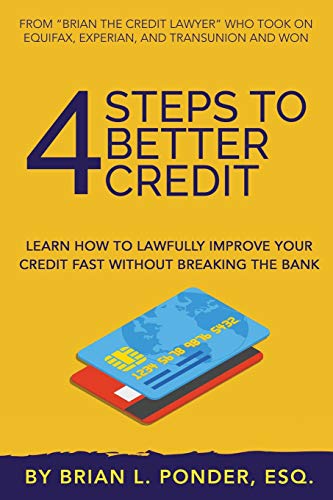
4 Steps to Better Credit by Brian L. Ponder, Esq.

“4 Steps to Better Credit”

By Brian L. Ponder. A plain-language guide to understanding a consumer file and acting on it lawfully.

The book walks through obtaining a consumer file disclosure, reading it line by line, identifying what is inaccurate or incomplete, and disputing it through the channels the Fair Credit Reporting Act provides, with records kept at every step.

It is an education book. It teaches a process the reader carries out personally, with the consumer reporting agency, the furnisher, or the debt collector concerned.

Available for purchase on Amazon.

Buy on Amazon

Paid consultations


Professional consulting for attorneys, firms, and businesses on consumer protection strategy and systems: how disputes arise, how consumer reporting and collection workflows succeed or fail, and how to build processes that comply with the Fair Credit Reporting Act and the Fair Debt Collection Practices Act.

This is consulting and education, not a law firm and not legal advice. Nothing here promises any score change, deletion, or outcome. Consultations are professional consulting on strategy and systems. They are not a service for repairing any individual’s credit.

Philanthropy

Quiet, practical support for children and for the school that serves them.

A school cannot teach well when children are too hot to concentrate and too hungry to learn. The work starts there.

The school

Support for a school that serves several hundred children, including some of the poorest children in its community. For many of those children, the school is the most stable place in the day: a classroom, a meal, and adults who know their names.

Classroom cooling

Funding classroom cooling so children can learn in tolerable conditions during the hot months. Heat in a classroom is not a comfort issue. It decides whether a lesson lands at all, for the children and for the teachers in front of them.

School meals

Supporting a school meal program so children eat during the school day. A child who has eaten can attend, participate, and stay through the afternoon. The meal program is part of the education, not an extra alongside it.

Ordinary infrastructure

Helping with the ordinary infrastructure a school runs on: classrooms kept in repair, supplies in the room when the term starts, and a place to play. None of it is glamorous. All of it is what a functioning school day is made of, and children’s programs depend on it holding together.

This work is personal and ongoing. It is described here because it is part of a complete picture of the practice and the person behind it.

About Brian L. Ponder

Former New York trial attorney. Now a consumer protection strategist and data breach forensics consultant.

Brian L. Ponder is a native of Quitman, Georgia. He earned a Bachelor of Arts in Psychology from Northwestern University (Evanston, IL) and a Juris Doctor from Southern University Law Center (Baton Rouge, LA). In 2021, Southern University Law Center recognized him with its Distinguished Alumni Award.

His career began in healthcare as a surgical neurophysiologist conducting neurophysiologic intraoperative monitoring during neurosurgery and spinal orthopedic surgery, then moved to establish his New York and multistate-federal court consumer protection trial law practice, representing consumers against consumer reporting agencies, debt collectors, and lenders. Across that practice he handled hundreds of matters in foreclosure defense, consumer reporting disputes and violations, and debt collection disputes and litigation on behalf of consumers and small business owners burdened by predatory loans and business deals, work that turned on a close reading of the consumer file, the furnisher’s records, and the statutory duties in the Fair Credit Reporting Act (FCRA), the Fair Debt Collection Practices Act (FDCPA), and other consumer protection statutes.

He discontinued his trial law practice in March 2026, and now works in two consulting practices: data breach forensics for counsel litigating breach cases on both sides of the caption, and consumer protection strategy consulting and education.

He is the author of “4 Steps to Better Credit” and “How to Grow Your Medical Practice by Certifying Patients on the Georgia Low THC Oil Registry,” and the founder of Credit Mastery, a consumer credit education platform. He is also the author of the medical journal articles “Effects of pain in the human neonate,” “Acute bradycardia as a result of intraoperative transcranial electric motor evoked potential stimulation: a case report,” and “Neurophysiologic intraoperative monitoring during percutaneous thoracolumbar kyphoplasty: A multimodality approach.”

Brian L. Ponder does not practice law and accepts no legal clients. Litigation is handled by licensed counsel. Forensic engagements are accepted only through counsel, and consumer protection consulting is consulting and education, not legal advice.
Education
Northwestern University, B.A. Psychology
Southern University Law Center, J.D.
Background
Healthcare, then New York consumer protection law practice
Current work
Data breach forensics consultant, through counsel
Consumer protection strategist
Office
745 Fifth Avenue, Suite 500
New York, NY 10151

Contact

Inquiries are reviewed personally. Select the topic that fits, and write plainly about the matter.

Inquiry topics

  • Data Breach Forensics for plaintiffs’ counsel
  • Data Breach Forensics for defense counsel
  • Consumer Protection Consulting
  • Philanthropy
  • Other

Consultation rates

$1,000 per hour and $500 for thirty minutes, for professional consulting. Forensic engagements for counsel are scoped and quoted as described on the Data Breach Forensics page.

Office

Brian L. Ponder
745 Fifth Avenue, Suite 500
New York, NY 10151
Phone: (646) 450-9461
Email: brian@brianponder.com

To reach the practice, email brian@brianponder.com or call (646) 450-9461.
Inquiries are reviewed personally. Forensic engagements are accepted only through counsel. Nothing submitted forms an attorney-client relationship. No passwords, account credentials, or full account numbers should ever be sent.